The real turning points of 2025 for merchants, partners, and developers
At first glance, 2025 might look like just another year of new Shopify features, but when you look a bit deeper, the real story becomes much clearer:
2025 was the year Shopify focused less on appearance and more on strengthening its foundation.
Themes, colors, and animations slowly moved to the background.
Instead, these questions took center stage:
- Is this store truly scalable?
- Is the checkout and post-purchase experience secure?
- How small is the margin for error in global sales?
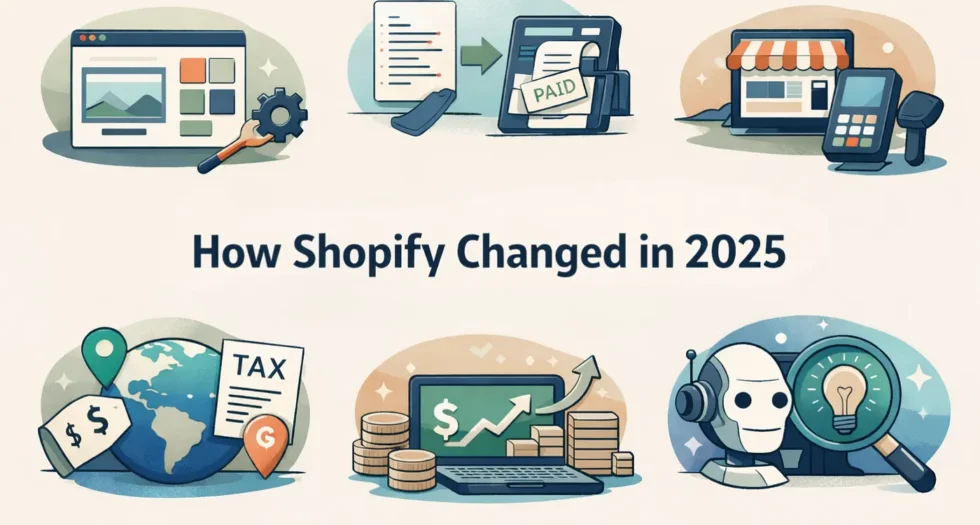
In this article, I’ve gathered six critical shifts that genuinely shaped the Shopify ecosystem in 2025.
1. The Theme Conversation Changed: “Looks Good” vs. “Works Well”
With the 2025 Summer Editions, Shopify sent a clear message:
A theme is no longer just about design.
It’s part of the infrastructure.
With the Horizon approach, we saw:
- more block-based structures
- more flexible layouts
- a more standardized development environment
For merchants, this meant speed. For partners and developers, it meant predictability.
But let’s be honest:
This shift also forced many legacy setups to struggle.
2025 became the year of letting go of old habits on the theme side.
2. Checkout and Post-Purchase
One of the hardest truths of 2025 was this:
The old script-based approach to checkout and post-purchase pages is no longer sustainable.
For the Thank You and Order Status pages:
- upgrade calls became clearer
- migration timelines were announced
- the path toward automatic transitions in 2026 was defined
This was painful for some merchants in the short term, but in the long run, it was unavoidable.
More secure checkout.
More stable tracking.
More standardized systems.
2025 was the preparation year for this transition.
3. Shopify POS and Retail
It didn’t make a lot of noise, but it mattered:
Shopify significantly strengthened its POS capabilities in 2025.
This clearly shows that Shopify is no longer just an “online store” platform.
It’s building a system where:
online and physical sales are managed from a single center.
This also signals a shift in Shopify’s growth strategy:
less focus on launching new stores, more focus on helping existing merchants grow.
4. Global Commerce
Throughout 2025, Shopify addressed some of the most painful issues in global sales:
- prices breaking when shipping addresses change
- incorrect tax calculations
- complex DDU scenarios
Draft Order and tax updates weren’t exciting, but the features that protect margins rarely are.
Shopify’s focus was clear:
reduce the margin of error.
5. 2025 for App Developers
For app developers, 2025 wasn’t just about shipping new features.
Changes around App Store revenue sharing made one thing very clear:
Only sustainable products will survive.
This pushed the ecosystem toward:
- clearer product focus
- fewer but more meaningful features
- stronger retention and support quality
For many teams, 2025 became a year of rethinking their direction.
6. AI: Visible in 2025, Embedded in 2026
AI became much more visible across Shopify in 2025.
But toward the end of the year, the real signal emerged:
AI is no longer just a management tool.
It’s moving toward discovery and sales channels.
It’s still early.
But the direction is unmistakable.
A Quick Look Ahead to 2026
The “Renaissance” language used in Shopify Editions isn’t accidental.
The key themes for 2026 are already clear:
- more automation
- more centralized multi-channel selling
- AI-supported decision-making
2025 laid the groundwork for this shift.
To Summarize
2025 was not the year of “Let’s change the theme.”
It was the year of “Build solid infrastructure, increase clarity, and align with standards.”
And that says a lot for both merchants and developers.